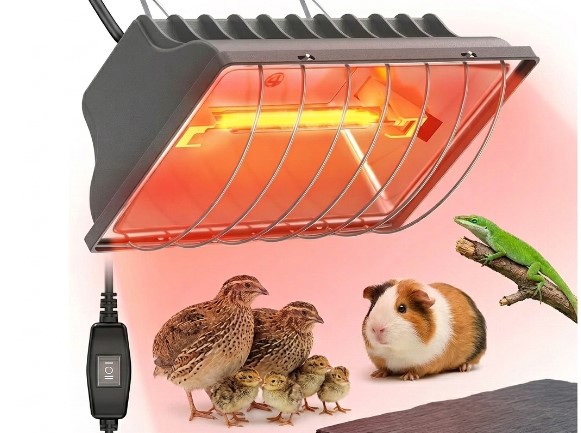
How Long Do Chicks Need a Heat Lamp? The Handbook for Healthy Development
As chicks develop feathers to help regulate their body temperature:
It is important to reduce the brooder temperature by approximately 5°F (3°C) each week during weeks 1-5 to allow them to acclimate to the change. Observing the feather development on chicks is an important way to determine their readiness to transition off of heat support.
• Only Down Feathers: Need heat support consistently
• Partially Feathered: Reduced heat support is acceptable
• Fully Feathered: Generally, they do not need a heat lamp
Chicks typically become fully feathered in 5 – 6 weeks, but this will vary based on breed. Some breeds feather faster than others, while some may take longer.
Behavior and Chicks
Chicks show their comfort level through their behavior. Watching chicks can help you assess and adapt conditions more appropriately than using thermometers.
• Chicks that are too cold will huddle tightly under the lamp and be very loud.
• Chicks that are too warm will be away from the heat source and pant.
• Chicks that are comfortable will be evenly distributed throughout the brooding area, calm and quiet.
The behavioral cues given by your chicks are essential in determining how long to leave heat support lamps on your chicks in your particular conditions.
Effects of the Environment and Season
Many factors affect heat lamp use, depending on the conditions. These factors can be impacted greatly by external factors.
• Cold climate: Chicks may require the full 6 weeks of heat.
• Warmer weather: Chicks may decrease their heat sooner.
• Indoor brooders: Generally, have more stable temperatures, causing a decrease in the length of heat support.
• Outdoor brooders: Given temperature fluctuations, they generally require longer periods of heat support.
Even in warmer climates, it is common for temperatures to drop at night, and therefore, will require consistent monitoring.
When trying to determine the length of time that a chick will require a heat lamp, the general time frame will vary from 4 to 6 weeks, depending on the chick breed and the conditions in which they live.
Feather Development: The Natural Indicator for Transitioning Off the Heat Lamp
To ensure that you have an accurate understanding of chick feathering stages and their approximate relationship to transitioning from needing a heat lamp to not using a heat lamp, please use these guidelines.
Heat lamps are a very important piece of equipment when raising poultry. However, improper use of heat lamps can be dangerous because heat lamps can overheat and cause fires. To ensure the safe use of heat lamps, follow these safety tips:
• Always securely fasten the lamp so that it cannot fall off.
• Make sure that your heat lamp has sufficient wattage to accommodate the size brooder you are using.
• Ensure that there is adequate ventilation in the area where you utilize the heat lamp.
• Keep flammable items away from the heat lamp.
When working with heat lamps, you can have consistent heat output as well as conform to the requirements of the National Electric Code using reliable lighting sources such as lamps4u.shop.
When chicks have attained the majority of their feathers and are actively moving about, it is time to taper off the use of a heat source. If you carefully follow these steps, the process will go smoothly.
1. Turn off the heat lamp during the warmest portion of the day.
2. Closely monitor the chicks to determine if they need the lamps' assistance for warmth.
3. If necessary, turn the lamp back on for nighttime warmth.
4. After the chicks are comfortable and no longer require the lamp, remove the heat lamp completely.
This way, by tapering off the use of a heat lamp, you will reduce the amount of stress that the chicks experience and enable them to naturally adjust to their environment.
There are several mistakes to be avoided when trying to determine how long chicks require a heat lamp:
• Removing the heat source too early will result in illness and reduced growth rates.
• Providing heat for too long will cause the chicks to depend on the heat source and may result in overheating.
• Not observing the behavior of the chicks before making temperature adjustments will result in providing the incorrect temperature.
• Requiring the use of different types of heat sources will create stress for the chicks.
Utilizing a balanced approach, based on both observation and historical data timelines, is the most effective way to eliminate mistakes.
Conclusion: It is all About Observation, Not Just a Time Frame
How long do chicks require a heat lamp? The average chick will require a heat lamp for approximately four to six weeks. The actual answer will rely on chick behaviors, environmental variables, and feather development.
Chick rearing success comes from watching (not following a strict schedule). You need to be able to see when the chicks have developed full feathers, are consistently spaced apart, and are very active, so that you know it's time to take away artificial heat.
You can develop a safe, secure, and healthy environment for the chicks to grow in from day one by carefully observing chicks, then creating an area that meets their needs (proper equipment), and by changing their environment gradually.